New BRICS cable a network free of US eavesdropping

bricscableBRICS countries are close to completing a brand new Internet backbone that would bypass the United States entirely and thereby protect both governments and citizens from NSA spying.

In light of revelations that the National Security Agency hacked German Chancellor Angela Merkel’s phone, in addition to recording information about 124 billion phone calls during a 30-day period earlier this year, the fallout against the NSA has accelerated.

Brazil is set to finalize a 34,000-kilometre undersea fiber-optic cable by 2015 that will run from Vladivostok, Russia to Fortaleza, Brazil, via Shantou, China, Chennai, India and Cape Town, South Africa.

According to the Hindu, the project will create, “a network free of US eavesdropping,” which via legislative mandates will also force the likes of Google, Facebook and Yahoo to store all data generated by BRICS nations locally, shielding it from NSA snooping.

“The BRICS countries have the muscle to pull this off,” notes Washington’s Blog. “Each of the BRICS countries are in the top 25 largest economies in the world. China has the world’s second largest economy, India is 3rd, Russia 6th, Brazil 7th, and South Africa 25th.”

However, some privacy experts fear that this will do little to stop the NSA, given that it has tapped undersea cables since the Cold War era. Others are more positive.

“Any alternative would be a positive thing, writes Michael Dorfman. “The more choice you have, the better. Yet no-one can say for sure whether this new Internet will be safer than its US counterpart and will be able to protect the rights of regular users, including the privacy of personal data and free access to resources, more effectively.”

The BRICS cable was already in development months before the revelations of whistleblower Edward Snowden first became public in June.

In September it emerged that the NSA had been spying on Brazilian government communications as well as Brazilian oil company Petrobras. Spooks hacked into the firm’s computer network to eavesdrop on conversations between CEOs.

The current Internet architecture is dominated by ICANN (the Internet Corporation for Assigned Names and Numbers), which is largely controlled by the United States.

Other entrepreneurs are also fighting back against NSA surveillance. Tech maverick John McAfee recently announced that he was to fund a $100 gadget named Decentral that would sync up with a modem to thwart NSA spying and provide total anonymity.

Asked what he would do if the US government banned the product, McAfee responded, “I’ll sell it in England, Japan, the Third World. This is coming and cannot be stopped.” – prisonplanet.com

The new Silk Route

arabicChina’s likely sale of sophisticated missiles to Turkey over the objections of its NATO allies might have angered Washington and other capitals, but it should not have been a surprise.

Even as the U.S. has spent billions of dollars and lost hundreds of lives in Iraq and Afghanistan, Beijing has been quietly upping its presence in the Middle East.

Militarily, the U.S. – which maintains a permanent aircraft carrier presence near the Gulf as well as dozens of other warships and major bases in Turkey, Qatar and the United Arab Emirates – is by far the dominant regional power.

China has tended to follow Russia’s lead on the Middle East, sometimes appearing sidelined on issues such as Syria.

Beijing’s economic, political and diplomatic clout, however, is growing fast. China’s Ministry of Commerce said last month China-Arab nation trade now reaches $222 billion a year, 12 times its 2002 level. That would outstrip U.S.-Mideast trade, valued at $193 billion in 2011.

Militarily too, China’s footprint is rising. As well as maintaining a three-ship antipiracy task force in the Indian Ocean and occasionally sending ships to the Mediterranean, Beijing has deployed UN peacekeepers to Lebanon.

Turkey’s choice of a $3.4 billion deal to acquire the Chinese FD-2000 missile defence system rather than rival U.S. or European systems may be a sign of things to come.

“It is a wake-up call,” said Christina Lin, a former U.S. official and now fellow at the School for Advanced International Studies who last year briefed the Pentagon’s Joint Chiefs on the issue. “China is looking to get a lot more involved in the Middle East and is being increasingly accepted there.”

China’s interests in the region, she said, ranged from energy and investment to countering the spread of jihadist militancy, a major worry for Beijing in its Muslim provinces.

The firm that makes the missile system, China Precision Machinery Import and Export Corp (CPMIEC) is under US sanctions for violations of the Iran, North Korea and Syria Nonproliferation Act. While Turkish officials said the deal was not yet officially finalised, it was likely to go through.

U.S. and other NATO officials complain it may not be compatible with other NATO systems and may increase the risk of cyber attack or other interference across the alliance. The Chinese Foreign Ministry said Western states were overeacting to what was essentially simply a commercial decision.

Mixing commerce and geopolitics, experts say, is at the heart of Beijing’s approach. Chinese officials have become regular visitors to most Mideast states while a range of regional leaders including Turkey’s Tayyip Erdogan, Israel’s Benjamin Netanyahu, Palestinian leader Mahmoud Abbas and Jordan’s King Abdullah have all visited China.

The aftermath of the “Arab Spring” and Washington’s abandonment of longtime proxies such as Egypt’s Hosni Mubarak, some analysts say, has left some governments keen to find alternative allies. Even longtime U.S. partners feel the draw.

“I personally have close friendly relations with various Chinese leaders, current and former,” Jordan’s Abdullah told Chinese media last month. “We are interested in building on this relationship… because China plays a vital role in promoting world peace and stability and has an influential role in regional issues.”

Beijing has long been a major supplier of small arms to the region – the Stockholm International Peace Research Institute this month reported 2006-10 sales to Egypt, Jordan, Lebanon and Qatar. Still, the Turkish deal is seen as a major breakthrough for its advanced weapon sales.

China’s soaring energy needs are seen as a major motivator, coming just as the U.S. gets closer to energy independence and budget constraints and public reluctance hit its military presence.

The International Energy Agency expects China’s Mideast oil imports to grow from 2.9 million barrels per day in 2011 to 6.7 million in 2035, a projected 54 percent of total Chinese oil imports.

Already, Chinese national oil companies are amongst the biggest players in Iraq and Iran and Beijing is both Saudi Arabia’s largest trading partner and the biggest single purchaser of Iran’s crude.

That purchasing power has effectively allowed China and other Asian powers to determine how successful U.S. and European sanctions on Iran over its nuclear program can be.

In the long run, some analysts suggest Beijing’s oil needs could actually bring it closer to the West, particularly on Iran. The Stockholm International Peace Research Institute says Chinese defence sales to Tehran have already notably fallen.

“If Washington (were to) substantially reduce its military presence in the region, oil security concerns might compel Beijing to play a larger role in defusing the primary threat to the free flow of oil – the closure of the Strait of Hormuz,” former CIA energy analyst Erica Downs told a congressional probe into Chinese trade practices earlier this year.

“NEW SILK ROUTE”

China’s regional ambitions, however, go well beyond defence deals and oil. While some 75 percent of U.S.-Mideast trade remains energy-related, China has deliberately diversified and says more than half its regional trade is now non-energy.

Last month, China hosted a five-day China-Arab States Expo in Its north-west Ningxia Hui Autonomous region.

“Though the trade growth is fast, there is still room for improvement,” Zhu Weilie, director for the Centre for China-Arab States Co-Operation Forum Studies told Xinhua. “The two sides should enhance mutual trust to improve communications in political, economic and cultural fields.”

Infrastructure projects have been a major focus. Port operator Cosco owns part of Egypt’s Port Said container terminal. Rail ventures include Medina to Mecca in Saudi Arabia, Mediterranean to Red Sea in Israel and Ankara to Istanbul in Turkey.

In the longer term, there is also talk of linking Turkey and Central Asia to China by rail, providing Chinese goods access to Europe through what some analysts call “a new Silk Route”.

Ultimately, Chinese investment may prompt the kind of backlash already seen in Africa. Its attempts to befriend everybody may also prove unsustainable – its stance on Syria has already irritated some Gulf states and prompted an angry protest at its embassy in Libya.

For now, however, it remains broadly welcomed. In July, a Pew Centre survey showed China viewed more positively than the U.S. in every Mideast state except Israel.

“If you talk to diplomats in the Gulf, they are very impressed,” former U.S. official Lin said. “Chinese ambassadors in the region tend to speak very good, classical Arabic while the Americans still expect everyone to talk in English.” – Reuters

Britten’s indifference

One very positive side-effect of the Red October protest was that it aired the stale house of the MSM in Mandelatopia. This breath of fresh air made the usual suspects, and a few newbies, cough convulsively, as expected.

The loudest convulsion was a coarse phlegm-ejecting piece by the foul-mouthed Irish colonial reject Chris McEvoy. It is not worth reading. The second raffish algospasm was by Georgina Guedes. She tried, via an attempt at irony, to persuade her readers that it was oh so bleeding-heart symbolic of the freedom of democratic expression in Mandelatopia seeing a “dignified” black policeman escorting and “protecting” the white Red October marchers. She somehow conveniently forgot that the “dignified” policeman’s colleagues killed another peaceful protester, Mark Tatane, not so long ago – not even to speak of the Marikana massacre, the 1000-plus deaths per year in police custody since 1994, or the fact that both the ex-bosses of the “dignified” policeman are criminals.

The third bawdy paroxysm came from Lady Nicky Falkof, fresh from her 14-year sabbatical at the feet of Her Majesty the Queen of England. Her strident call for “progressive language” (e.g. rights, minorities, diversity, etc.) to remain the sole moral property of those who run Manor Mail & Guardian – at the behest of the Queen and her moneymongers – is only out-cramped by her near-autistic fixation with proper syntax and correct spelling. I’ll deal with Miss Commonwealth Spelling Bee 2013 in my next column.

The most interesting throe was thrown by the ever-so-swanky MSM darling, Sarah Britten. Her piece, albeit well-argued and neatly packaged, was pure sentiment. And it was precisely this appeal to emotion which prompted me to, once more, put my theory about white liberal irrationality to the test.

It only took six tweets of 140 letters/characters each to confirm said theory.This was how it was done. I simply asked her if she supported black lesbians protesting against “corrective” rape. She answered in the affirmative, of course. Then I pointed out that rape affects all women, not just black lesbians. Meaning that black lesbians form a sub-group protesting that which affects them specifically namely “corrective” rape. But, as mentioned before, rape affects all women, not just black lesbians.

From this it follows that it is logically and, even more importantly, morally inconsistent to laud one sub-group (black lesbians, in this case) for their “discriminatory” form of protest – i.e.they only protest against corrective rape, and not all rape – whilst demonising another (in this case, Red October whites) by accusing them of partaking in a “discriminatory” form of protest.. based on the fact that crime affects all, not just whites. Ergo, the rationale underpinning the protest by whites against their slaughter at the hands of blacks is no different to that of black lesbians protesting against corrective rape. Yet, the former is demonised while the latter is lauded and applauded by Britten and her MSM ilk.

It suffices to say that that which is good for the black lesbian goose is not good for the Red October white gander. This means that people like Britten discriminate on the basis of race – in terms of the above-mentioned biased sentiments expressed publicly. Given the above context, and what we know from all the standard definitions of racism, this would make Britten a racist.

Yet I doubt whether Britten could be classified as a racist, for she loves all those whites and blacks, et cetera, who agree with her. Meaning that her irrationality must be founded on something other than race-based zealotry. Or is it?

Britten is part and parcel of the upper-class British establishment in Mandelatopia. This group is the richest and (still) most influential collective in the country. They are just another appendage of her Majesty the Queen of England. And, as we know, England is the fons et origo of Pax Britannica. This (former) global empire was built by men like Cecil John Rhodes… whose moral motivations can best be summed up by the following quote; “

I contend that we British are the finest race in the world and that the more of the world we inhabit the better it is for the human race. Just fancy those parts that are at present inhabited by the most despicable specimens of human beings what an alteration there would be if they were brought under Anglo-Saxon influence…

At first glance the above quote seems like the paragon of racism. Not even Verwoerd ever said anything remotely similar. But I think it goes deeper than that. Is it “hate”? I mean, you really need to dislike others quite a lot to refer to them as “despicable specimens of human beings”. In short: are upper-class Brits like Britten hateful racists, like their forebearers, like Rhodes?

I think not. They are simply indifferent to all others, other than themselves. If dislike were an adjective, hate would be its comparative… and indifference its superlative. I mean it is beyond hate to, for example, kill 33 000 women and children in concentration camps and coldly go about carrying out a scorched-earth policy which reduced a unique nation to the poorest white nation on the planet, just for the sake of gold and diamonds. Similarly, it is beyond hate to try and turn the whole population of one of the oldest civilisations on the planet, the Chinese, into opium drug addicts… simply because your love of/for tea caused a huge trade deficit at the time.

It is a cardinal mistake to think that this indifference has, somehow, mysteriously vacated the non-soul of the British upper-class. Just think about the following fact: England is the only country in the Western world which (still) has such a huge divide between the upper and middle class. This divide is rigorously enforced, by complete indifference to the wishes and aspirations of the British middle and lower classes.

And this indifference is still very much present in modern South Africa. Just listen to Nobel Prize winner Nadine Gordimer – a representative of the British elite in this country:

Afrikaner women are lower than rats, closer related to plants, just fit enough to be raped in an act of genus preservation.

Lovely lady, ain’t she? She may have said “hate”, but it is clear from the magnitude of her hate that it is indifference. They only disguise their indifference as hate, so as to appear as if they actually give a continental toss… as if they actually still have one shred of humanity left.

Meaning that the imperial indifference that was once projected (and protected) by the military might of the old British Empire has simply morphed into an imperial indifference enforced by morality. In short; what the sword did for Rhodes, neo-liberalism (à la Pax Brittanica) is now doing for Gordimer, Britten and their useful idiots like Helen Zille, boy-man Fransie Cronje, Eusebius McKaiser, Piet Croucamp, Djonitin Jansen, Anton van Niekerk, Tim du Plessis, Max du Preez, Leopold Scholtz, Willie Esterhuyse, FW de Klerk and ilk.

Therefore never think that they actually care. They feel zilch for other nations, other peoples, cultures, traditions and their moral idiosyncrasies. They are completely indifferent to the plight of all others, especially poor blacks and the white farmers in this country.

The quickest way to rid this warm country of these cold bastards would be to unleash Raka in the form of a Mugabe-Malema on them. But that would lead to wanton slaughter; something the Afrikaner, unlike the British upper-class, has not got the stomach for, unfortunately. The Afrikaner hates wanton slaughter… that is why they organized the Red October protest.

The most humane way to ship their pitiless afters back to their crappy little mud-island with its Islam(ic) weather (partly Sunni, mostly Shiite) would therefore be to treat them with the exact same indifference they display towards all and sundry on the planet. Now that would be cricket, wouldn`t it, Sarah?

The warmongers: not looking out for us

mercer_ilanaby Ilana Mercer

[followbutton username=’IlanaMercer’ count=’true’ lang=’en’ theme=’light’]

Like Ilana Mercer’s Facebook page

To listen to U.S. government officials there is only an upside to the punitive sanctions imposed on Iran by the United States and a reluctant European Union. Consequently, the emphasis is forever on how to toughen the punishment; never on whether to lift economic sanctions on the long-suffering people of Iran.

But what about the effects of trade boycotts on American businesses?

Chris Harmer of The Institute for the Study of War estimates that the Boeing Company alone forfeits a minimum of $25 billion in business every year because of U.S.-imposed sanctions on Iran, a niche market that is filled by the Russians. Overall, Harmer puts the value to U.S. business of trade lost due to the economic embargo on Iran at approximately $50 billion per annum.

For example, Iran imports $1.5 billion worth of cars a year, the beneficiaries of which are companies like Nissan, Toyota and Peugeot (when they might have been General Motors and Chrysler). Peugeot does an added half a billion dollars’ worth of commerce with Iran just in car parts.

The Iranian economy, moreover, has diversified and is adapting to life without the U.S. The rest of the world—pockets in Europe and most of Asia—has not isolated Iran, with the result that the country has many trading partners other than the U.S. And while Iran has lost petroleum revenue due to sanctions, the trend will not endure. China, Japan and South Korea are hungry for the country’s crude.

Not to be overlooked are the costs to Americans of sanction enforcement, avers Harmer. In addition to the opportunity costs—the missed business aforementioned—there are “direct costs.” The Office of Foreign Asset Control in the U.S. Treasury Department squanders around $1 billion a year in developing lists of “financial institutions that are subject to sanctions,” and then infringing on the rights of individuals and companies to freely exchange privately owned property.

“Indirect costs” are incurred in the course of cultivating a massive U.S. intelligent infrastructure—a veritable alphabet soup of agencies—upon which the Treasury draws in enforcing a regimen of sanctions.

Into the Cannibal's Pot

So, too, are the “deterrent costs” borne by the American taxpayer who pays for patrolling the Persian Gulf, the Northern Arabian Sea and the Strait of Hormuz.

Ultimately, trade, not democracy, is the best antidote to war with Iran. The more economically intertwined countries become, the less likely they are to go to war. More than boycotts, barter with Iran is bound to promote goodwill and reduce belligerence on both sides.

As a general rule, state-enforced boycotts harm honest, hard-working Americans who use the economic means to earn their keep. They benefit servants of Uncle Sam—the political class and its media and think-tank hangers-on. For they deploy the political means to advance their ends and grow their sphere of influence. As libertarian economist Murray Rothbard once observed, these “are two mutually exclusive ways of acquiring wealth”—the economic means is honest and productive, the political means is dishonest and predatory.

As always, it’s us against them: the state versus the people who labor outside it and in spite of it.

For now, Obama’s eager response to Iranian overtures has sidelined Syria. Before Syria recedes in memory—to be replaced by demands for action against Iran—it’s worth considering one constant quantity: the media guttersnipes and their motivation.

The bobbingheads of TV have been complaining in the most unctuous terms that Russia and Syria have pulled one over us. The U.S., they lament, has been weakened, evidently, because someone halted the momentum of war.

You see, the chattering and political classes cannot conceive of greatness outside the state because they are part of the state apparatus and depend on it for status and income.

Conversely, individual Americans—who have nothing to gain and only losses to sustain from war—should never conflate their interests with those of the government and its emissaries, who have everything to gain from the great theatre that is war.

More than anyone, who benefits when America goes to war? Those who “function within the nimbus of great power” in D.C. and around it—the media-military-congressional-industrial complex.

Thus did Charles Krauthammer ridiculously equate the failure to go to war against Syria with “Russia supplanting America as regional hegemon.”

Krauthammer was joined by others, not least of them Bill O’Reilly and his sidekick Dennis the Menace. How diminished will the bluster of both media mouths be if the U.S. is no longer dictating the terms of war (lots of it) and peace (too little of it) in the world? Their immense egos will suffer. Maybe even their incomes, eventually.

But not you, the everyday American.

Putin stopped a war in Syria. This is not the same as “supplanting” American power. Rather, the Russians replaced bully power with a balance of power, and this is good for ordinary Americans.

He who saves you from war is better than he who sends you to war. The proof is in the Putin.

[followbutton username=’IlanaMercer’ count=’true’ lang=’en’ theme=’light’]

Like Ilana Mercer’s Facebook page

©2013 By ILANA MERCER

For syndication rights to http://BarelyABlog.com or http://IlanaMercer.com, contact ilana@ilanamercer.com. Read more.

Obama talks to Rouhani

Pres. Rouhani
Pres. Rouhani

President Obama announced today that he talked on the phone with Iranian president Rouhani: “Just now I spoke on the phone with President Rouhani of the Islamic Republic of Iran,” he said. “The two of us discussed our ongoing efforts to reach an agreement over Iran’s nuclear program.”

This is the first time leaders from America and Iran have spoken since 1979.

“I reiterated to President Rouhani what I said in New York. While there will surely be important obstacles to moving forward and success is by no means guaranteed, I believe we can reach a comprehensive solution.

“I’ve directed Secretary Kerry to continue pursuing this diplomatic effort with the Iranian government. We had constructive discussions yesterday in New York with our partners, the European Union, the United Kingdom, France, Germany, Russia, and China, together with the Iranian foreign minister, and going forward, President Rouhani and I have directed our teams to continue working expeditiously in corporation with the P-5 plus one to pursue an agreement. And throughout this process we will stay in close touch with our friends and allies in the region, including Israel.

“Now we are mindful of all the challenges ahead. The very fact that this was the first communication between an American and Iranian president since 1979 underscores the deep mistrust between our countries.”

Obama said that “Iran’s supreme leader has issued a fatwa against the development of nuclear weapons, President Rouhani has indicated that Iran will never develop nuclear weapons.”

“I have made clear that we respect the right of the Iranian people to access peaceful nuclear energy in the context of Iran meeting its obligations. So the test will be meaningful, transparent, and verifiable actions,” said Obama, which could lead to a relaxation of sanctions.

Obama talked of a new relationship between the U.S. and Iran, if his diplomatic efforts succeed. – TWS

Kenya to host first yuan clearing house in Africa

Kenya wants to host a clearing house for China’s yuan currency – a bold African first that would deepen the continent’s ties with Beijing, already a big investor from The Cape to Cairo.

Such a venture would not eclipse the dollar in Africa anytime soon, however, because the yuan is tightly managed and traders are wedded to the greenback’s flexibility.

Africans can already get quotes for their currencies against the yuan . A clearing house would cut the need for dollar settlements, speed things up and reduce costs.

yuanBut the real prize for Kenya, or any other African host, would be the symbolism of being the continent’s business gateway with Asia’s economic emperor, even if business starts modestly.

Such an exchange would also be the first outside Asia.

Its prospect is a measure of China’s challenge to Africa’s traditional partners in Europe and the United States and reflects the increasing attractions of a continent with some of the world’s fastest growing economies.

“Even if the benefits to business have probably been slightly overblown by diplomats on both sides, I don’t think you can understate the symbolic aspect,” said Shilan Khan, Africa economist at London-based Capital Economics.

China’s ties with Africa have expanded fast.

In 2012, the total volume of China-Africa trade reached $198.49 billion, a rise of 19 percent over the previous year, Chinese government figures show. China accounted for 18.1 percent of Africa’s total trade volume in 2012, up from 3.8 percent in 2000.

“The proposal is basically to consider Kenya favourably given that the financial market is deep here,” Kenyan Finance Minister Henry Rotich told Reuters in August, citing rivals such as Nigeria, which already holds some reserves in yuan.

South Africa had a financial centre that dwarfs Kenya’s and has been mooted as a potential host, though officials there have not said they are pursuing such a plan.

“We are sort of competing and at the end of the day, the Chinese government is the one to decide where this clearing house will be,” Rotich said, making his pitch for east Africa’s biggest economy which aims to become a financial hub.

Early signals look good for Kenya.

“We are very positive about this clearing house and I think it is very important for Kenya to set up a financial hub here and to process the Chinese currency renminbi,” China’s ambassador to Kenya, Liu Guangyuan, told Reuters on the sidelines of a conference in Nairobi on Wednesday.

The value of potential business through such a clearing house was still a subject of discussion, he said.

Kenya’s daily turnover of foreign exchange is $330 million to $370 million, sometimes rising to $500 million.

Highlighting Nairobi’s enthusiasm for a clearing house based in Kenya’s central bank, President Uhuru Kenyatta made his bid for Beijing’s backing during a visit to China in August.

Business between Kenya and China is growing, even if Europe is still a bigger trade partner. Kenya’s Equity Bank, for example, has opened a branch in Nairobi for Chinese business executives, complete with Chinese tellers serving them.

“Everyone is trying to clinch a deal to directly clear and settle yuan transaction with the People’s Bank of China,” said an official at a Chinese state think-tank that often advises Beijing on policy, speaking about Africa’s clearing house plans.

In the meantime government officials in Niger have reportedly found evidence of bloated costs in oil deals with China National Petroleum Corporation (CNPC), leading the government to seek renegotiations on sections of
its contracts with CNPC. In Chad, CNPC operations have been suspended due to alleged “gross environmental negligence”, reports The New York Times.
Gabon, in another controversial move, will also be reclaiming Sinopec assets in 2015, because of breaches of contract, according to Macau- Daily Times

In August Chad’s oil minister Djerassem Le Bemadjiel told state radio that the Chadian government had “found flagrant violations of environmental standards by […] CNPC.

Not only do they not have facilities to clean spilled crude, there were also intentional spillages in order
reduce costs”, reported Reuters.

African entrepreneurs seek their Chinese dream

africa-phone-sellerFrom a windowless room in a dilapidated Hong Kong high-rise, Ali Diallo sells Chinese electronics to retailers across Africa. The modest surroundings belie the multi-million dollar business the West African trader has built in the five years since he moved to the city.

The 39-year-old from Guinea is part of a growing number of African entrepreneurs thriving in southern China, as trade between the world’s second-largest economy and fastest-growing continent soars.

Sitting in a small room cluttered with cardboard boxes destined for Nigeria, Diallo welcomes the latest delivery of Chinese-made mobile phones to his office in Chungking Mansions — a bustling labyrinth better known for budget hotels and no-frills restaurants.

The building is also the go-to place in Hong Kong for African buyers in search of cheap electronics, with phones selling from around $8 each.

“In China there are opportunities for people who can start from scratch and build up their own business. Obviously not in one day but through hard work and networking you can do it,” says the trader, whose company sees an annual turnover of $11 million a year through the sale of phones and tablets alone.

Trade between China and Africa hit new highs of nearly $200 billion last year, according to official Chinese data, driven by Chinese industry’s appetite for African raw materials.

The African traders in southern China are the flipside of this deepening relationship. Entrepreneurs like Diallo have made Chungking Mansions one of the most important passageways for Chinese gadgets air-freighted to Africa.

According to Gordon Mathews, professor of anthropology at the Chinese University of Hong Kong, up to a fifth of all mobiles in Africa have passed through the building’s corridors in recent years.

But while this 17-storey hive is the storefront, the engines behind this trade lie in the industrial heartland of neighbouring Guangdong province in southern China.

This mecca for low-cost manufacturing has drawn entrepreneurs from across Africa, creating one of the largest black communities in Asia.

In the provincial capital Guangzhou, at least 20,000 Africans live in the city, research from local Sun Yat-sen University shows.

Though their number is a fraction of the million Chinese now living in Africa, these migrants are playing a pivotal role in their new home.

“Traders bring with them vast skills and capital, supporting large amounts of Chinese manufacturers… If all the African traders were to vanish it would have an enormous effect on the south China economy and business people realise this rather strongly,” says Mathews.

Many traders work in and around a downtown neighbourhood dubbed “Little Africa”, or more insensitively “Chocolate City” by the local media. Along its winding central alley, a restaurant serves Tilapia with fufu — a staple Congolese meal of fried fish and cassava — as well as traditional Chinese fried rice and steamed fish.

A few kilometres away at Canaan Export Clothes Trading Centre, a vast complex where Igbo is spoken as often as the local Cantonese language, Lamine Ibrahim loads thousands of jeans into bags destined for Africa.

He is one of several hundred Africans who has forged a deeper connection to the city by marrying a local Chinese woman — a relationship founded on love but also economic prudence.

“For (communication) with the Chinese people… she can do. I buy my car, she is there, I open my own factory, she is there. So if I have no wife it’s not easy,” says the Muslim trader from Guinea in broken English.

Five months ago Ibrahim and his wife Choi Zoung-mai — renamed Maryam Barry after converting to Islam — opened their first factory hiring 43 Chinese workers. With this latest investment they hope to secure a bright future for their four-year-old son who speaks fluent Mandarin as well as French, English and Fula.

While there are several success stories, not all African entrepreneurs make it in China — for some rising costs and intense competition make it difficult to stay afloat. But this migrant community, which began forming in Guangzhou in the 1990s, has built a network of groups to support each other’s ambitions.

This is vividly apparent in the handful of African Pentecostal churches that have sprung up across the city. Tucked away on the ninth floor of a building behind Guangzhou railway station, 150 worshippers crowd into Royal Victory Church.

“Our prayer is that you will prosper,” the pastor preaches to cries of agreement from a mostly male congregation drawn from Nigeria, Cameroon and Ghana.

The African entrepreneurs who are flourishing in Guangzhou are succeeding where many foreigners fail. Not only are they navigating the notorious Chinese bureaucracy but at times overt racism in a country where prejudices can run high.

This can range from mild snubs from taxi drivers who refuse to pick up black customers to more serious accusations of traders being unfairly targeted by police when they conduct raids for illegal immigrants.

Even so others report good relations with the Chinese. “Many traders feel much more comfortable working in China than they do in Europe,” says Roberto Castillo, a Lingnan University researcher in Guangzhou.

Ojukwu Emma, president of the local Nigerian community, says the main problem for Africans trading in China are the increasing clampdowns on visas. He says it is getting harder for African residents in the city to renew visas, or for those travelling back and forth to gain re-entry.

“You cannot allow foreigners to come in and not give the foreigner confidence to stay. Once you are out to the world, you must be open,” says the businessman who has lived in the city for 16 years.

But for now booming Sino-African trade continues to draw new waves of African entrepreneurs, drawn to the shores of Guangzhou in search of the Chinese dream. – AFP

BRICS agree on structure of bank

bricsbankThe BRICS bloc of large emerging economies have agreed on the capital structure for a proposed development bank that aims to reduce their reliance on Western financial institutions, the Wall Street Journal reported.

Officials from Brazil, China, India, Russia and South Africa agreed to set up the bank with a total capital of $50 billion, shared equally among them, it quoted an unnamed senior Indian government official as saying.

The decision was made at a meeting in New Delhi in the first week of August, the newspaper said. The move would likely end disagreements over the funding and management of the bank as China had earlier proposed total bank capital of $100 billion and sought a bigger share, it said.

The bank would support the financing needs in emerging and developing nations for roads, modern-day port facilities, and reliable power and rail services.

Officials have previously said the BRICS aimed to inject an initial $50 billion into the bank, but there was disagreement over whether each state should contribute $10 billion or if contributions should vary by the size of their economies.

China’s economy is about 20 times the size of South Africa’s and four times as big as Russia’s or India’s. Other key issues, such as proposals within the group to offer a stake to developed nations, needed further discussion, the Indian official said. The group is considering offering a stake of 40-45% to non-BRICS nations, the official added.

That would help the bank get a higher credit rating and enable it to raise cheaper funds from the market, the newspaper said. The bloc has yet to make a decision on where the bank would be located, the official added.

Those issues are likely to be discussed when finance ministers from the group meet on the side-lines of the annual meetings of the World Bank and International Monetary Fund in Washington in October, the official added.

The five countries represent a fifth of global GDP but have struggled to find common ground that would convert their economic weight into joint political clout. – Reuters

Syria: Another Western war crime in the making

Dr Paul Craig Roberts

by Paul Craig Roberts

Update:

The war criminals in Washington and other Western capitals are determined to maintain their lie that the Syrian government used chemical weapons. Having failed in efforts to intimidate the UN chemical inspectors in Syria, Washington has demanded that UN Secretary General Ban Ki-moon withdraw the chemical weapons inspectors before they can assess the evidence and make their report. The UN Secretary General stood up to the Washington war criminals and rejected their demand. However, as with Iraq, Washington’s decision to commit aggression against Syria is not based on any facts.

The US and UK governments have revealed none of the “conclusive evidence” they claim to have that the Syrian government used chemical weapons. Listening to their voices, observing their body language, and looking into their eyes, it is completely obvious that John Kerry and his British and German puppets are lying through their teeth. This is a far more shameful situation than the massive lies that former Secretary of State Colin Powell told the UN about Iraqi weapons of mass destruction. Colin Powell claims that he was deceived by the White House and did not know that he was lying. Kerry and the British, French, and German puppets know full well that they are lying.

The face that the West presents to the world is the brazen face of a liar.

Washington and its British and French puppet governments are poised to yet again reveal their criminality. The image of the West as War Criminal is not a propaganda image created by the West’s enemies, but the portrait that the West has painted of itself.

The UK Independent reports that over this past week-end Obama, Cameron, and Hollande agreed to launch cruise missile attacks against the Syrian government within two weeks despite the lack of any authorization from the UN and despite the absence of any evidence in behalf of Washington’s claim that the Syrian government has used chemical weapons against the Washington-backed “rebels”, largely US supported external forces, seeking to overthrow the Syrian government.

Indeed, one reason for the rush to war is to prevent the UN inspection that Washington knows would disprove its claim and possibly implicate Washington in the false flag attack by the “rebels,” who assembled a large number of children into one area to be chemically murdered with the blame pinned by Washington on the Syrian government.

Another reason for the rush to war is that Cameron, the UK prime minister, wants to get the war going before the British parliament can block him for providing cover for Obama’s war crimes the way that Tony Blair provided cover for George W. Bush, for which Blair was duly rewarded. What does Cameron care about Syrian lives when he can leave office into the waiting arms of a $50 million fortune.

The Syrian government, knowing that it is not responsible for the chemical weapons incident, has agreed for the UN to send in chemical inspectors to determine the substance used and the method of delivery. However, Washington has declared that it is “too late” for UN inspectors and that Washington accepts the self-serving claim of the al Qaeda affiliated “rebels” that the Syrian government attacked civilians with chemical weapons.  See also Syria Accepts UN Inspectors, US Spurns Call as ‘Too Late’.

In an attempt to prevent the UN chemical inspectors who arrived on the scene from doing their work, the inspectors were fired upon by snipers in “rebel” held territory and forced off site, although a later report from RT says the inspectors have returned to the site to conduct their inspection.

The corrupt British government has declared that Syria can be attacked without UN authorization, just as Serbia and Libya were militarily attacked without UN authorization. In other words, the Western democracies have already established precedents for violating international law. “International law? We don’t need no stinking international law!” The West knows only one rule: Might is Right. As long as the West has the Might, the West has the Right.

In a response to the news report that the US, UK, and France are preparing to attack Syria, the Russian Foreign Minister, Lavrov, said that such unilateral action is a “severe violation of international law,” and that the violation was not only a legal one but also an ethical and moral violation. Lavrov referred to the lies and deception used by the West to justify its grave violations of international law in military attacks on Serbia, Iraq, and Libya and how the US government used preemptive moves to undermine every hope for peaceful settlements in Iraq, Libya, and Syria.

Once again Washington has preempted any hope of peaceful settlement. By announcing the forthcoming attack, the US destroyed any incentive for the “rebels” to participate in the peace talks with the Syrian government. On the verge of these talks taking place, the “rebels” now have no incentive to participate as the West’s military is coming to their aid.

In his press conference Lavrov spoke of how the ruling parties in the US, UK, and France stir up emotions among poorly informed people that, once aroused, have to be satisfied by war. This, of course, is the way the US manipulated the public in order to attack Afghanistan and Iraq. But the American public is tired of the wars, the goal of which is never made clear, and has grown suspicious of the government’s justifications for more wars.

A Reuters/Ipsos poll finds that “Americans strongly oppose U.S. intervention in Syria’s civil war and believe Washington should stay out of the conflict even if reports that Syria’s government used deadly chemicals to attack civilians are confirmed.”  However, Obama could not care less that only 9 percent of the public supports his warmongering. As former president Jimmy Carter recently stated, “America has no functioning democracy.” It has a police state in which the executive branch has placed itself above all law and the Constitution.

This police state is now going to commit yet another Nazi-style war crime of unprovoked aggression. At Nuremberg the Nazis were sentenced to death for precisely the identical actions being committed by Obama, Cameron, and Hollande. The West is banking on might, not right, to keep it out of the criminal dock.

The US, UK, and French governments have not explained why it matters whether people in the wars initiated by the West are killed by explosives made of depleted uranium or with chemical agents or any other weapon. It was obvious from the beginning that Obama was setting up the Syrian government for attack. Obama demonized chemical weapons–but not nuclear “bunker busters” that the US might use on Iran. Then Obama drew a red line, saying that the use of chemical weapons by the Syrians was such a great crime that the West would be obliged to attack Syria. Washington’s UK puppets, William Hague and Cameron, have just repeated this nonsensical claim. The final step in the frame-up was to orchestrate a chemical incident and blame the Syrian government.

What is the West’s real agenda? This is the unasked and unanswered question. Clearly, the US, UK, and French governments, which have displayed continuously their support for dictatorial regimes that serve their purposes, are not the least disturbed by dictatorships. They brand Assad a dictator as a means of demonizing him for the ill-informed Western masses. But Washington, UK, and France support any number of dictatorial regimes, such as the ones in Bahrain, Saudi Arabia, and now the military dictatorship in Egypt that is ruthlessly killing Egyptians without any Western government speaking of invading Egypt for “killing its own people.”

Clearly also, the forthcoming Western attack on Syria has nothing whatsoever to do with bringing “freedom and democracy” to Syria any more than freedom and democracy were reasons for the attacks on Iraq and Libya, neither of which gained any “freedom and democracy.”

The Western attack on Syria is unrelated to human rights, justice or any of the high sounding causes with which the West cloaks its criminality.

The Western media, and least of all the American presstitutes, never ask Obama, Cameron, or Hollande what the real agenda is. It is difficult to believe than any reporter is sufficiently stupid or gullible to believe that the agenda is bringing “freedom and democracy” to Syria or punishing Assad for allegedly using chemical weapons against murderous thugs trying to overthrow the Syrian government.

Of course, the question wouldn’t be answered if asked. But the act of asking it would help make the public aware that more is afoot than meets the eye. Originally, the excuse for Washington’s wars was to keep Americans safe from terrorists. Now Washington is endeavoring to turn Syria over to jihad terrorists by helping them to overthrow the secular, non-terrorist Assad government. What is the agenda behind Washington’s support of terrorism?

Perhaps the purpose of the wars is to radicalize Muslims and, thereby, destabilize Russia and even China. Russia has large populations of Muslims and is bordered by Muslim countries. Even China has some Muslim population. As radicalization spreads strife into the only two countries capable of being an obstacle to Washington’s world hegemony, Western media propaganda and the large number of US financed NGOs, posing as “human rights” organizations, can be counted on by Washington to demonize the Russian and Chinese governments for harsh measures against “rebels.”

Another advantage of the radicalization of Muslims is that it leaves former Muslim countries in long-term turmoil or civil wars, as is currently the case in Iraq and Libya, thus removing any organized state power from obstructing Israeli purposes.

Secretary of State John Kerry is working the phones using bribes and threats to build acceptance, if not support, for Washington’s war crime-in-the-making against Syria.

Washington is driving the world closer to nuclear war than it ever was even in the most dangerous periods of the Cold War. When Washington finishes with Syria, the next target is Iran. Russia and China will no longer be able to fool themselves that there is any system of international law or restraint on Western criminality. Western aggression is already forcing both countries to develop their strategic nuclear forces and to curtail the Western-financed NGOs that pose as “human rights organizations,” but in reality comprise a fifth column that Washington can use to destroy the legitimacy of the Russian and Chinese governments.

Russia and China have been extremely careless in their dealings with the United States. Essentially, the Russian political opposition is financed by Washington. Even the Chinese government is being undermined. When a US corporation opens a company in China, it creates a Chinese board on which are put relatives of the local political authorities. These boards create a conduit for payments that influence the decisions and loyalties of local and regional party members. The US has penetrated Chinese universities and intellectual attitudes. The Rockefeller University is active in China as is Rockefeller philanthropy. Dissenting voices are being created that are arrayed against the Chinese government. Demands for “liberalization” can resurrect regional and ethnic differences and undermine the cohesiveness of the national government.

Once Russia and China realize that they are riven with American fifth columns, isolated diplomatically, and outgunned militarily, nuclear weapons become the only guarantor of their sovereignty. This suggests that nuclear war is likely to terminate humanity well before humanity succumbs to global warming or rising national debts.

Dr. Paul Craig Roberts was Assistant Secretary of the Treasury for Economic Policy and associate editor of the Wall Street Journal. He was columnist for Business Week, Scripps Howard News Service, and Creators Syndicate. He has had many university appointments. His internet columns have attracted a worldwide following. His latest book, The Failure of Laissez Faire Capitalism and Economic Dissolution of the West is now available.

Copyright © Paul Craig Roberts 2013.

Originally published on Paul Craig Roberts – Institute for Political Economy. Reproduced with the author’s permission. Contact information for syndication rights.

Mugabe’s inauguration ‘a victory against big Western powers’

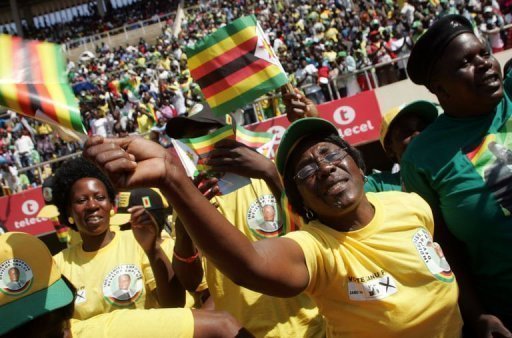
Flag-waving Mugabe supporters on 13 August 2013 in Harare (AFP file photo)

by Reagan Mashavave

Veteran Zimbabwean President Robert Mugabe hit out at “vile” Western critics as he was sworn in for another five-year term Thursday in a stadium packed with jubilant supporters.

Festooned in a sash, garland and medals, the 89-year-old dismissed accusations the July 31 election that returned him to power was rigged and vowed to rejuvenate the foreign-dominated banking and mining sectors.

Mugabe’s 33-year rule since Zimbabwe’s independence has been marked a drive to transfer foreign-owned and white-owned assets, including farms, to blacks.

“I promise you better conditions,” he told the 60,000 capacity crowd of supporters at a stadium in Harare.

“The mining sector will be the centrepiece of our economic recovery and growth. It should generate growth spurts across sector, reignite that economic miracle which must now happen.”

Mugabe’s inner circle has faced decades of international sanctions over rights abuses, and the veteran leader said he expected the punitive measures to continue.

“Most likely we shall remain under these sanctions for much longer.”

“We continue to look East,” Mugabe said lampooning, Western countries which have called into question the legitimacy of his election victory.

“We dismiss them as the vile ones whose moral turpitude we must mourn,” he said venting against Britain, Australia, Canada and the United States.

Former colonial power Britain called Thursday for an “independent investigation” into the conduct of the election, which Mugabe officially won by a landslide.

Unlike previous low-key investitures, Thursday’s event — replete with banners, flags and chants — carried strong echoes of Mugabe’s inauguration as prime minister of a newly independent Zimbabwe in 1980.

A no-show by many leaders from neighbouring countries — including President Jacob Zuma of regional power-broker South Africa — did little to dampen enthusiasm.

Neither did a boycott by opposition leader and former prime minister Morgan Tsvangirai, who insists the July 31 vote was stolen.

Mugabe was greeted in the stadium by thunderous cheers and whistling. On board a military truck he inspected assembled military personnel.

Gates to the Chinese-built stadium, the venue of Mugabe’s inauguration as president in 1987, opened shortly after dawn.

The day was declared a public holiday, helping boost attendance.

“Mr Mugabe, you are one of a kind,” sang a group of supporters slamming the sides of the minibus taking them to the stadium, while others waved fists as drivers honked their horns.

“It is a great day for Zimbabwe and the world will come to a standstill today,” said Alfred Tome, the Harare provincial administrator and spokesman for the organisers.

A concert will include artists from South Africa, Zambia and Jamaica –whose iconic singer Bob Marley played at Zimbabwe’s independence event.

Banners around the oval stadium carried messages praising African leaders and denouncing Western governments accused of meddling in Zimbabwe’s political affairs.

“Which African ever observed elections in Europe, America?” read one banner. “Africa has spoken, respect it’s voice,” said another.

The inauguration had been delayed after Tsvangirai challenged the poll results — which he denounced as “massive fraud” — in a petition to the Constitutional Court that was later withdrawn.

Among a series of complaints, Tsvangirai queried the suspiciously high number of voters who were turned away from polling stations in urban areas, which are considered opposition strongholds.

He also charged that his party’s supporters in rural areas were intimidated by Mugabe party backers into feigning illiteracy and voting in the presence of police and election officers.

The Constitutional Court confirmed Mugabe as president and declared the elections “free, fair and credible”, saying the results “reflected the free will of the people of Zimbabwe”.

‘Farewell event for Mugabe’

Eldred Masunungure, a political scientist from the University of Zimbabwe, said the event was at once Mugabe’s victory lap and his “last supper”.

“This inauguration is being projected as the crowning of a victory of a struggle for the past 13 years against big Western powers,” he said.

There is however also an “unintended meaning”, he said. “It can be read as a farewell event for Mugabe. It reminds one of Jesus’s Last Supper.”

The electoral commission declared Mugabe winner with 61 percent of the vote, against 34 percent for former prime minister Tsvangirai.

The vote ended a shaky power-sharing government formed by Mugabe and Tsvangirai four years ago to avoid a tip into all-out conflict following a bloody presidential run-off election in 2008.

Local observers judged the elections flawed and Western powers have raised serious doubts over the vote.

But regional groupings the Southern African Development Community and the African Union were less critical. – AFP

BRICS makes its presence felt

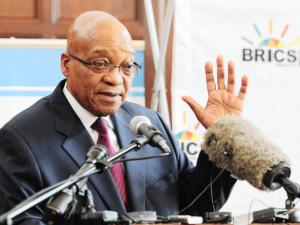
bricsTotal trade within the BRICS (Brazil, Russia, India, China, and South Africa) grouping amounted to $6.1 billion last year, President Jacob Zuma said on Tuesday.

“This represents 16.8 percent of global trade,” he told delegates at the BRICS business council meeting in Johannesburg.

“The presence and influence of the BRICS grouping continues to be felt.”

Zuma said the strength of BRICS was amplified by the fact that these countries accounted for 43 percent of the world’s population.

“Indeed, we are all gathered here because we see value in the BRICS partnership in many respects.”

In 2012, South Africa’s total trade with BRICS countries stood at R294bn, up from R264bn in 2011.

Total trade with Brazil grew from R18bn in 2011 to R20bn in 2012, and with Russia from R3bn in 2011 to R5bn in 2012.

Zuma said total trade with India, South Africa’s sixth largest trading partner, grew substantially from R53bn to R67bn.

Trade with China grew from R188bn in 2011 to R201bn in 2012.

“All these impressive statistics… should provide you with the determination and confidence to deliver on the imperatives…” he told delegates.

Trade and Industry Minister Rob Davies said the council meeting was intended to deepen the partnerships to enhance co-operation and development on the African continent.

BRICS council South African chairman Patrice Motsepe said it was crucial that the commitment to increase trade and investment was seen, and “quantifiable”.

“There’s a new sense of urgency,” Motsepe said.

He emphasised “value-added trade” and common objectives being sought.

“BRICS is not about excluding other countries,” said Motsepe.

“We want to see investments quantify… It is important to build on the BRICS partnership.” – Sapa

Aging Chinese apologise for Cultural Revolution ‘evil’

A poster from the days of the Cultural Revolution

by Carol Huang

As a teenager radicalised by China’s Cultural Revolution, Zhang Hongbing denounced his mother to the authorities. Two months later a firing squad shot her dead.

Now after more than 40 years of mounting guilt, Zhang has ruffled the silence that cloaks China’s decade of turmoil with a public confession.

Such rare apologies have been welcomed as a potential gateway to the collective soul-searching that could bring healing — but is blocked by a ruling Communist Party whose critics say is unwilling to confront its own responsibility.

“Back then everyone was swept up and you couldn’t escape even if you wanted to. Any kindness or beauty in me was thoroughly, irretrievably ‘formatted’,” Zhang told the Beijing News last week.

“I hope that from my self-reflection other people can understand what the situation was like at that time.”

The 1966-76 Cultural Revolution, unleashed by then-leader Mao Zedong to reassert power after the famines caused by his disastrous Great Leap Forward, inflicted myriad personal tragedies and threw society into chaos.

“Red Guard” youths abused their elders — officials, intellectuals, neighbours, relatives — dragging them into “struggle sessions”, ransacking their homes and driving some to suicide.

Many targets were jailed or killed, and while no official figure has been issued, one Western historian estimated half a million people died in 1967 alone.

Zhang reported his mother in 1970 for criticising Mao, and military officials came to their home, assaulted her and took her away.

But as the political winds changed — a few years after the Cultural Revolution ended, a court in his native central Anhui province recanted his mother’s sentence — Zhang began to rethink as well.

“I will never forgive myself,” he said.

Only a handful of public confessions have appeared, mostly in recent years as the Revolution’s once-heady teenagers enter their 60s.

Wen Qingfu from the central province of Hunan cited age as a spur for admitting in an essay in June that, following orders, he once led a mob to storm the home of a teacher whose son he often played with.

“When people get old they look back and reflect,” he told a provincial newspaper. “If I didn’t apologise now we would both get too old.”

Wen acted in time to see his victim’s daughter reply in a public letter on behalf of her frail mother: “You can let go of your guilt.”

Many Chinese have embraced these apologies, even though wide airing of past wrongs might invite a spate of legal action, said Ding Xueliang, a Cultural Revolution expert at Hong Kong University of Science and Technology.

In a rare trial stemming from the era, a court in Zhejiang province in April sentenced a man in his 80s to 42 months in prison for a 1967 murder.

Still, Ding said, “the positive consequences would go far beyond the negative ones… to collective soul-searching, to build a more law-based society”.

But China’s ruling party prohibits such discussion, which would inevitably broach the question of its own ugly role. Any trial or apology tends to skirt around this central issue, say academics.

“Individual responsibility is one part of this,” said Xu Youyu, a researcher at the Chinese Academy of Social Sciences.

“Some things are basic, for example, you can’t hit people or humiliate or persecute them.”

But the confessions “have not touched on the more important or fundamental issues,” he said, and if they did, “there might be a question of whether the discussion could continue”.

Shortly after Mao died in 1976 the campaign was ended, and the authorities hung blame on the controversial Gang of Four leaders headed by Mao’s wife Jiang Qing, jailing them in 1980.

The following year the official party line declared that the Cultural Revolution had dealt China “the most severe setback and the heaviest losses” since the founding of the People’s Republic in 1949.

Mao was deemed to have been 70 percent right and 30 percent wrong, having made “gross mistakes” but far greater contributions.

And with that a curtain over the matter was drawn.

Former premier Wen Jiabao briefly referenced the period last year, warning that China should never retread such “historical tragedies”.

The remark — seen as a rebuke to the recently disgraced leader Bo Xilai who had championed “red revival” — heartened those who support freer discussion of the decade, but the impact of Wen’s words ended there.

Virtually no museums, memorials or films in China explore the Revolution, except for little-known private efforts such as one museum in southwestern Sichuan province that refers discreetly to a “Red era”.

In a public apology published in June, Liu Boqin of Shandong province in the east detailed his crimes and listed his victims, but only vaguely referenced the political directives that drove him.

Instead he cited “youth and ignorance, being incited, wicked, not distinguishing right and wrong” for having hounded teachers and vandalised homes.

“Although being swept up in the environment of the Cultural Revolution was one reason,” he wrote, “I as an individual bear responsibility for my evil actions.” – AFP

Stolen twin babies found

chinese_babiesTwin baby girls allegedly stolen and sold by the obstetrician who delivered them in China have been recovered by police, state media reported Friday.

The girls, born last month in the northern province of Shaanxi, were allegedly victims of the same female doctor who sold a baby boy reunited with his parents earlier this week.

The obstetrician, Zhang Shuxia, told the twins’ mother in the delivery room that her babies had “deadly congenital diseases” and convinced her give them up, China National Radio reported.

Zhang also said their arms and legs were “broken” and stopped other relatives seeing them, the report added.

Similar details were described in reports this week about the boy, who police said was sold to a farmer with three daughters in the central province of Henan by alleged traffickers for 60,000 yuan ($9,800).

The doctor and two other suspects were detained after the boy’s family became suspicious and reported their case to police. The blaze of publicity surrounding his recovery has prompted a wave of others to come forward.

One of the girls was found in Shandong province, more than 500 kilometres (310 miles) from her birthplace in Fuping county, and her sister around 160 kilometres away in Shanxi province, the website of the People’s Daily said citing local authorities.

So far five officials have been sacked in Fuping, including the director of the county’s health department and the head of the hospital where the children were born, the official Xinhua news agency said.

Police had received reports of 55 possible incidents by Thursday, including 26 allegedly involving Zhang, it added.

Lou Qinjian, governor of Shaanxi, on Thursday called the case “vile” and vowed to punish those responsible “seriously”, it said.

Fuping is the home county of the family of Chinese president Xi Jinping.

Trafficking of children is a serious problem in China, blamed in part on the “one-child” policy which has put a premium on baby boys, with girls sometimes sold off or abandoned.

Under the policy, aimed at controlling China’s vast population of more than 1.3 billion, people who live in urban areas are generally allowed one child, while rural families can have two if the first is a girl.

In a much publicised case, Chinese police rescued 89 children and arrested 355 suspects in December after breaking up a series of child trafficking rings. – AFP

Germany: US snooping poses risk of data theft, industrial espionage

germanindustryGerman companies believe the US now poses almost as big a risk as China when it comes to industrial espionage and data theft, a survey has revealed.

The startling finding of a survey of 400 companies conducted in mid-July underscores the shift in German public and business opinion caused by revelations about US surveillance activities.

Some 26 per cent of German managers, IT and security professionals described the US as a high-risk place for industrial espionage and data theft, according to the survey commissioned by EY, the consultancy.

This was second only to the 28 per cent of respondents who view China as a particularly high-risk country for industrial espionage. Russia was ranked third, with 12 per cent saying it posed a significant risk.

When they were asked the same question two years ago only 6 per cent of German companies described the US as a high-risk centre for industrial espionage and data theft.

“Until now [German companies] mostly identified China and Russia as the location of [potential] attackers. Now companies realise that western intelligence agencies also employ very comprehensive surveillance measures,” Bodo Meseke, executive director of fraud investigation and dispute services at EY, said.

US surveillance has become a core issue in Germany’s election campaign following disclosures about Prism, the US data mining programme, and reports in Der Spiegel, the German magazine, that the US has spied on EU offices and is obtaining around 500m pieces of metadata a month from Germany.

Opposition parties have pressed ministers to obtain answers from the US on the extent of any spying on German soil, and the Federation of German Industry has described media reports about US surveillance as “concerning”.

Following meetings in Washington last month, Hans-Peter Friedrich, Germany’s interior minister, assured German industry that the US National Security Agency had not engaged in industrial espionage in Germany.
The US says its cyber activities are focused on combating terrorism and do not target companies, in contrast to China, which Washington accuses of cyber snooping to obtain corporate secrets.

These assurances do not appear to have convinced a significant portion of Germany’s business community.

Germany’s dependence on high-tech exports means the protection of patents and intellectual property are of perennial concern. Modern Germany’s tolerance of mass surveillance is also far lower than in other countries because of their experience of Nazism and East Germany’s Stasi secret police.

German companies continue to view business competitors in foreign countries as a bigger espionage threat than state intelligence agencies, according to the EY survey.

There are signs that disclosures made by Edward Snowden, the former NSA official turned whistleblower, are affecting the cloud computing industry, which involves storage of data and software on huge external servers rather than local hard drives.

A separate survey carried out last month by the Cloud Security Alliance, a trade body, found that 10 per cent of non-US members had cancelled plans to use a US-based cloud provider. Some 56 per cent said they would be less likely to use a US cloud company in future. – FT